
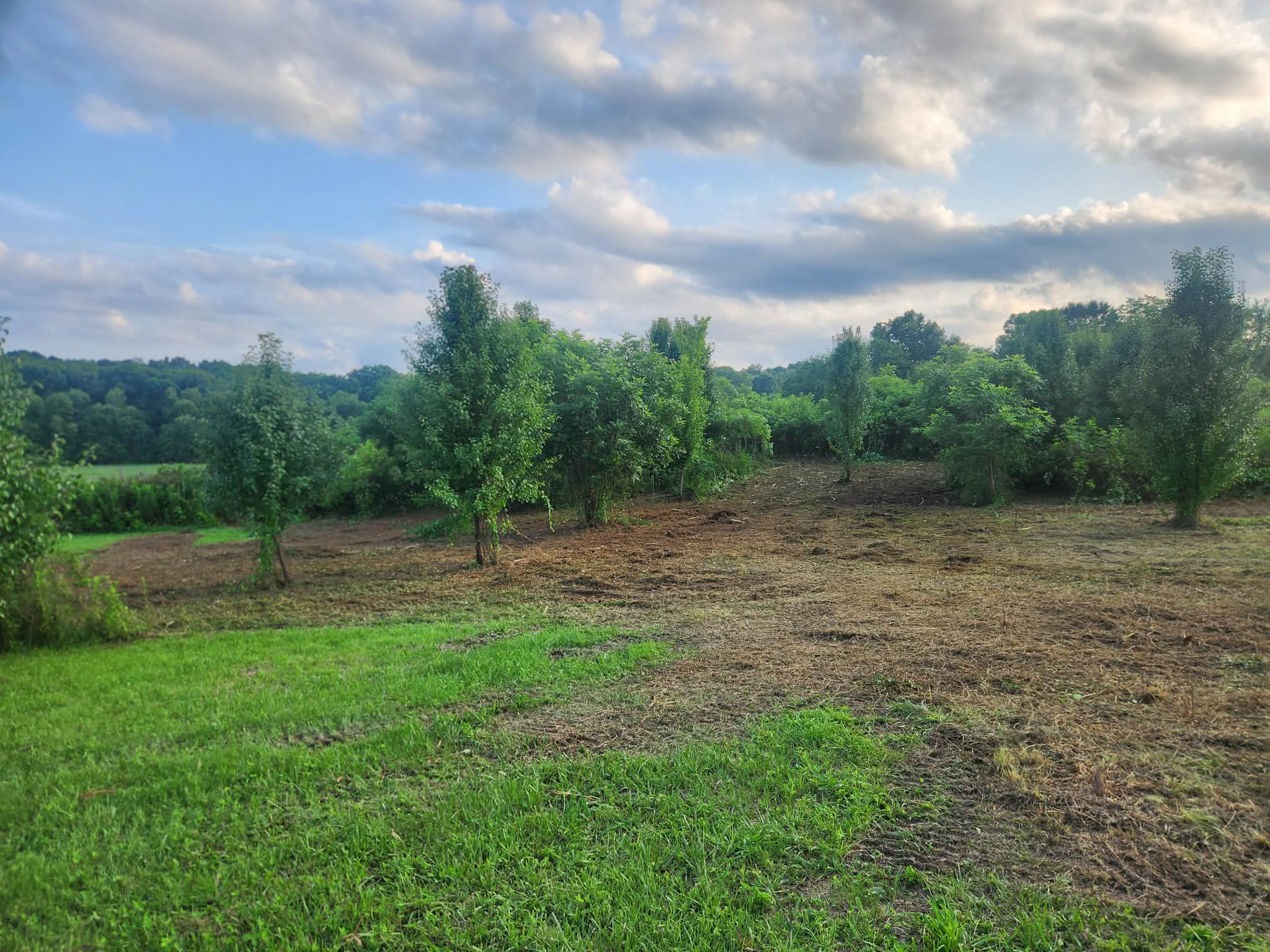
Fence Rows That Creep
A row nobody touched for fifteen years is often eight to twelve feet wider than the map says. Reclaiming that on a long field is measurable acreage, not just tidiness.
Service Area · Chillicothe, OH
Ross County straddles the glacial line. Flat, tillable ground on one side of the river, Appalachian hill country on the other, and the clearing problem is different on each.
Chillicothe is where flat Ohio stops. West and north of the Scioto the ground is glaciated: level, deep-soiled, and farmed in big blocks. East and south it is unglaciated hill country running toward Tar Hollow and Scioto Trail. One county, two entirely different conversations about clearing.
On the farm side the work is almost always linear: fence rows, ditch banks, waterway edges, and field corners that have crept in a few feet a year until somebody measured. On the hill side it is tracts: wooded acreage bought for hunting or for a homesite, where the understory has closed in and the good timber is buried in brush.
Mulching fits both because nothing gets stacked, burned, or hauled. If the goal is bare soil for a build pad, that is land clearing. If it is strictly the fence line, look at brush removal.
The Land Around Chillicothe
The Scioto valley through Chillicothe is wide, flat, and productive, and the fields out toward Frankfort and Kingston are farmed accordingly. What overgrows there is not the field. It is everything around the field. Osage orange, black locust, honeysuckle, and volunteer walnut take the fence rows and the ditch banks, and they take a little more of the tillable acre every season.
South and east, past Londonderry and toward the state forests, the hills start and never really stop. Those tracts are steeper, rockier, and heavily wooded, and the work there is understory rather than edges: opening a stand back up so you can walk it, hunt it, or find a building site in it.
A row nobody touched for fifteen years is often eight to twelve feet wider than the map says. Reclaiming that on a long field is measurable acreage, not just tidiness.
Brushy ditch banks slow drainage and make a bank harder to inspect. Mulching leaves the root mat holding the bank, which matters more here than a clean look does.
Past the glacial line the ground behaves like southern Ohio again: steeper, thinner soil, more rock. Same machine, slower pace, different plan.
Common Around Here
Fence rows and field corners, cut back to the actual line. On a section of row-crop ground that is real acreage returning to production.
Ridge lots east of town sell on the view and the trees. Selective mulching opens the pad and the sightline while the timber you bought the lot for stays standing.
Set-aside acreage goes to woody growth on a schedule. Mulching resets it without burning and without hauling anything to the road.
Honeysuckle under a good hardwood stand is the most common complaint we get from Ross County landowners. Take the understory, keep the canopy.
Straight Answers
Which side of the glacial line you are on sets the pace. Open, level fence-row work covers ground fast; a steep wooded tract east of town does not. Stem size does the rest. Mature osage orange in a fence row is slow going compared to honeysuckle of the same volume. Send photos and a rough acreage for a real number, usually within 24 hours.
Yes, and it is worth saying how. Mulching cuts at the stump rather than ripping roots, so there is no digging near a tile line and no spoil pile to spread. Mark any tile outlets, risers, or shallow runs you know about and we stay off them. A tracked machine also keeps ground pressure low enough to work the headland without compacting it.
Tell us before we quote it. Ross County has a genuinely dense concentration of Hopewell earthworks, and plenty of them sit on private ground. Mulching does not disturb soil, which makes it far safer than dozing near a feature, but we will still keep the machine off a known site and stay outside a buffer you set. If you are unsure what you have, the Ohio History Connection is the right call to make before anyone starts.
Late fall after harvest and winter before field work are the easy windows, and they are also when the leaves are down and the ground is firm. We schedule farm fence-row work around your calendar, not ours.
Yes, along with Bainbridge and the rest of Ross County. Pike County to the south is routine for us as well.
Free Estimate
Three fields to start. Mention whether it is fence row, field edge, or a wooded tract. Those price very differently.
Same Trip For Us
Ross County and the towns along US 23 and US 50 are one run for us. Not listed? Ask. We work past this line regularly.
Working somewhere else in the region? Start with forestry mulching across Southern Ohio and Eastern Kentucky, or go back to the BlueGrid home page for the full service area.
Step 1 of 5
We'll reach out within 24 hours, usually a lot sooner. While you wait, see what your property could look like.