
Straight Answers
Forestry Mulching & Land Clearing FAQs
Everything landowners ask us before the machine comes off the trailer: how we price, what we need from you, what we will not do, and what the ground looks like when we leave.
These are the general questions: pricing, scheduling, insurance, access, and what happens afterward. Questions about a specific service live on that service’s own page, and each section below links across to them. If you would rather know who you are dealing with first, read about BlueGrid.
Estimates & Getting Started
Estimates & Getting Started
How a job goes from a phone photo to a machine on your property.
By the acre or by the day, whichever fits the ground better. Open, even growth prices cleanly by the acre; a property with scattered heavy stems, awkward access, or a lot of hand-work around obstacles usually prices better by the day, and we will tell you which one we are quoting. Three things move the number more than total acreage does: stem size, slope, and how easy it is to get a truck and trailer in. That is why photos taken from ground level are worth more to us than a satellite view.
Property lines you can show us on the ground, a way in for a truck and trailer, and anything you want left standing marked with flagging or paint. Tell us about septic lines and leach fields, waterlines, wells, buried electric to a barn or well house, old fence wire, and anything else under the surface. That list is the single most useful thing a landowner gives us. If you are not sure where a line runs, say so and we will work around the uncertainty rather than through it.
Most quotes go out within 24 hours of getting your photos. Scheduling normally runs a couple of weeks out, longer in late winter and early spring when everyone decides at once that this is the year they deal with the back field. Storm work jumps the queue. A blocked driveway or a tree on a building gets moved to the front. If your job is time-sensitive because of a closing date, a planting window, or hunting season, tell us up front and we will be honest about whether we can hit it.
Only for the walk-through at the start. Once we have agreed on boundaries, keeper trees, and anything to avoid, you are free to go to work and come back to finished ground. Plenty of our jobs are on property the owner visits a few times a year. We do ask that you or someone you trust does the final walk with us before the machine goes back on the trailer, because that is the moment to say "take another pass there" while we are still standing on it.
Not inside our regular service area. That is built into the price. Well past it, a small job sometimes does not justify the haul on its own, and when that is the case we say so rather than quoting a number inflated by drive time. Often the answer is to wait until we have other work in your direction, and we will tell you if that is likely.
Choosing the Right Service
Choosing the Right Service
Which service actually fits the problem you are looking at.
They solve different problems. A brush hog is a rotary mower. It cuts soft growth and grass a few inches off the ground and does it fast and cheap, but it will not touch woody stems much bigger than your thumb, and it leaves everything it cannot cut standing. A forestry mulcher grinds stems up to roughly eight to ten inches flush with the ground and turns them into chips. If your field is grass and light weeds, a brush hog is the right tool and cheaper. If it has gone to saplings, briars, and cedar, a brush hog will bounce off it.
Ask what the ground has to do next. If you want it usable, walkable, huntable, or mowable, mulching gets you there faster and cheaper, and the chip layer holds the soil. If you need to build on it, run heavy equipment across it, put in a pond, or plant a row crop, you need the stumps and root mat gone. That is land clearing. A lot of properties want both: mulch the bulk of it, then clear the smaller footprint where the barn or the driveway is actually going.
Usually, and it is almost always cheaper than two trips. Mobilizing the equipment is a real cost, so combining a fence line, a trail, and a few acres of overgrown field into one visit spreads that across the whole job. Tell us everything you are thinking about when you ask for the estimate, even the parts you are not sure you want yet. It costs nothing to price and it may change what the whole job costs.
Either. Mulching cuts at the stump rather than pulling roots, so aggressive species will push new growth, meaningfully by year two or three on honeysuckle and multiflora rose. A short return visit to knock back that regrowth costs a fraction of the original clearing, because there is far less material and the ground is already open. Plenty of landowners put us on a rotation every two or three years and never let it get away from them again.
Yes. Utility corridors, right-of-way, commercial lots, subdivision frontage, and work for townships and counties. Insurance certificates, W-9s, and whatever paperwork your procurement process needs are not a problem. Tell us about site rules, required hours, or traffic control when you ask for the estimate, because those affect the schedule more than the clearing does.
On Your Property
On Your Property
Boundaries, buried lines, and everything we are careful about.
Yes. We carry general liability and we will send a certificate of insurance before the machine leaves the shop. You do not have to ask twice. Ask every contractor who quotes your property for one. A company that hesitates, promises to send it later, or gets defensive about the question is telling you something useful, and clearing work involves heavy equipment operating near buildings, fences, and other people.
We stop at whatever you can show us on the ground. Survey pins, flagging, an existing fence, or a paint line are all fine. What we will not do is cut toward a boundary that only exists on a plat in a filing cabinet, because a mulcher does not un-cut anything and clearing a neighbor's timber is an expensive mistake for everyone. If the line has not been walked in twenty years, get it flagged before we start. We would far rather delay a job than guess.
Mulching does not dig, so it is inherently safer around buried lines than any clearing method that moves soil. That said, shallow lines exist, and a stump ground too low over a waterline is still a bad day. Call 811 before we come if there is any public utility on the property. It is free and it takes a few days. Private lines are not covered by 811 at all: electric to a barn, a well house, a pond pump, or a septic field is yours to point out, and we will keep the head high or stay off entirely wherever you tell us to.
A tracked carrier spreads its weight far better than a wheeled machine, so on firm ground it usually leaves nothing worse than flattened grass. Wet ground is a different conversation, and if the only route to the back of your property crosses a soft yard we will tell you before we start rather than after. Gravel drives are generally fine; we can put down mats on a paved apron if turning tracks on it is a concern.
Yes, and it is worth planning. Cattle and horses need to be moved off the section we are working, both for their safety and because a curious animal will walk straight into a work area. Tell us which gates must stay closed and we will treat that as a rule rather than a preference. If we are clearing a fence line, mark any section you want left alone and point out where old wire is buried in the growth. Hidden wire is one of the few things that genuinely damages a mulching head.
Equipment & Conditions
Equipment & Conditions
What we run, and what stops us.
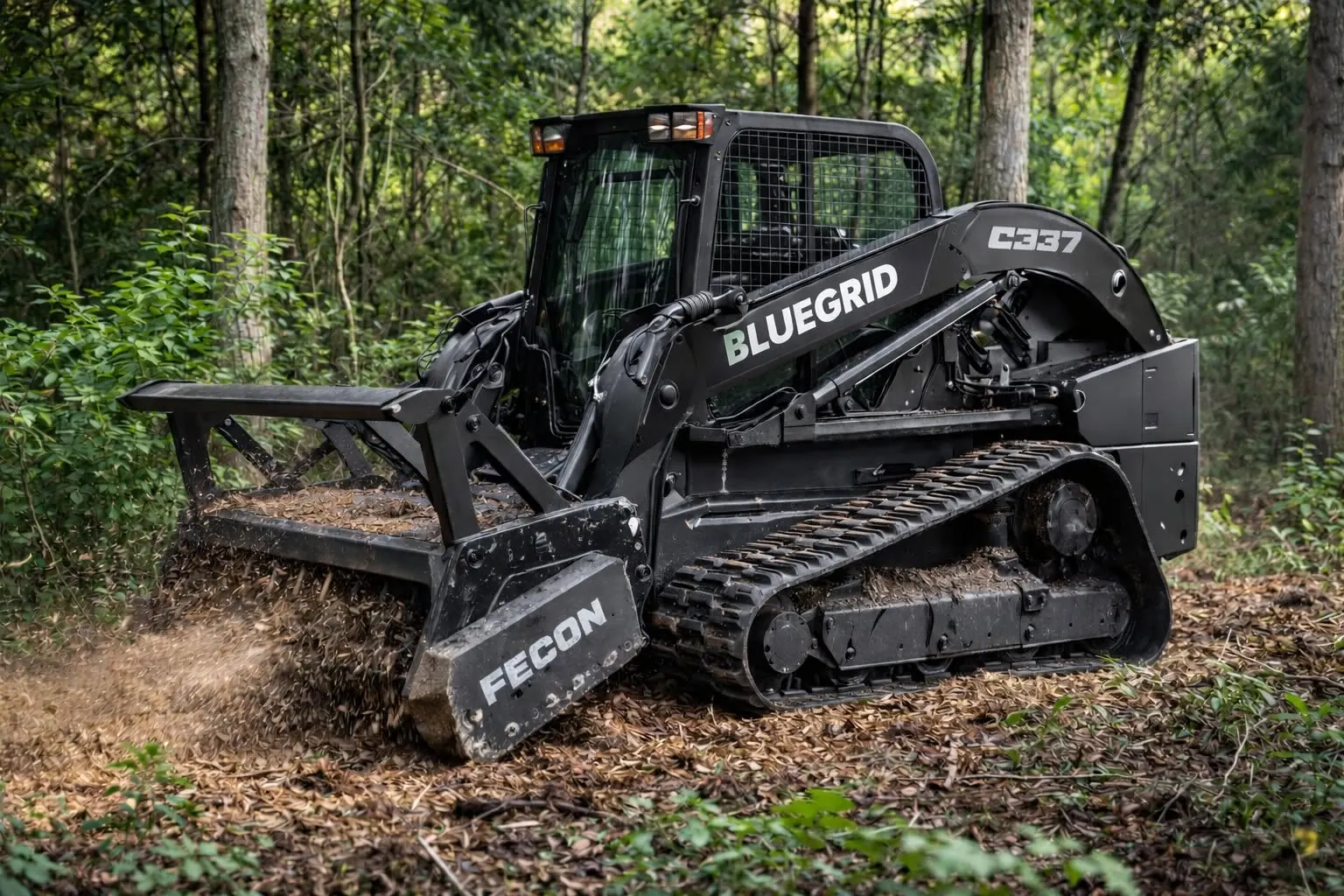
A tracked carrier with a drum mulching head. One machine, one operator, on and off the trailer in a morning. Tracks matter more than horsepower on the ground around here: they hold a side slope, they float better on soft bottomland, and they leave a track instead of a rut. It also means we are not staging a convoy of equipment on your property, which is part of why mulching costs less than traditional clearing on most jobs.
Less than you would guess, and less than a pickup truck across the same ground. Spreading the weight over two long tracks rather than four contact patches is the whole point, and it is why a mulcher can work a pasture in early spring that a wheeled skid steer would bury itself in. There is still a limit. Saturated bottomland after a wet week is worth waiting out, and we will say so rather than leaving you with ruts to look at for two years.
Rain during the day rarely does; a week of it beforehand often does. Frozen ground is the opposite. It is some of the best clearing weather of the year. Late fall through winter is our favorite window: the leaves are down so the operator can actually see the ground and the property lines, the stems are dormant, the bottoms are firm, and there are no ticks or snakes in the brush. Summer work is perfectly doable, it is just slower and harder on everyone.
We call you rather than letting you wonder. A job pushed to a firm week costs exactly the same as one forced through mud, and it leaves your property in far better shape, so we would rather move it. If you are on a hard deadline, tell us at the estimate stage so we can build slack into where you land on the calendar.
Weekends, sometimes. Just ask. After dark, no. A mulching head throws material and the operator needs to see stumps, rock, wire, and boundary flagging clearly; working a slope in poor light is how equipment and people get hurt. If your project has a genuine time constraint we will add days rather than hours.
After the Job
After the Job
What you are left with, and what to do with it.
An even layer of wood chips over open ground, with the stumps cut flush or close to it and whatever you asked us to keep still standing. It does not look like a manicured lawn on day one. It looks like land you can finally walk across and see over. Within a season the chips grey out and settle, and by the second year most of it has broken down into the soil.
You can rake or push it into piles if you want a specific area bare, though that is work you are paying for twice. Burning a fresh chip layer is difficult and not something we recommend. It smolders, it is hard to control, and it destroys the erosion protection you just paid for. If you know in advance that you want a section bare, tell us at the estimate and we will spread that area thinner or plan it as light clearing instead.
It depends on how thick the mat is, which is something we can control if you tell us the plan up front. A heavy chip layer will hold seed off the soil and tie up nitrogen as it breaks down, so grass struggles for a season. If pasture, lawn, or a food plot is the goal, say so before we start and we will spread the material thinner so you can seed sooner. For food plots specifically, see our hunting property prep work.
Not in any way that matters out in a field, which is where nearly all of this material ends up. Wood chips on open ground dry out, break down, and do not form the kind of continuous moist wood contact that causes problems. The ordinary precaution applies near structures: do not bank a deep chip layer against a wooden sill or siding. If we are mulching close to a house or barn, tell us and we will keep the material back from the foundation.
Payment & Paperwork
Payment & Paperwork
Estimates, deposits, and what you get in writing.
Always, and free. You get the scope in plain language: what we are clearing, what we are leaving, roughly how long it takes, and what it costs. That gives you something to hold us to and something to compare against another quote. If you are comparing bids, check that the other one specifies the same stem size and the same acreage; a cheaper number covering less ground is not actually cheaper.
For larger jobs, typically yes. It holds your date on the calendar and covers mobilization. Small jobs are usually settled on completion. Whatever applies to your project is written on the estimate before you agree to anything; you will not find out about a deposit after the fact.
Check or cash, and electronic transfer for commercial and municipal work that needs it. Payment is due when the job is finished and you have walked it with us, not before the work is done. If your organization runs on purchase orders and net terms, that is fine, just tell us at the estimate stage so the paperwork is set up in advance.
Yes, and we will send it without being chased. If you need your name or your company added as a certificate holder, or you are a township or county with specific coverage requirements, send us the requirements with your request and we will get it issued correctly the first time.
Free Estimate
Still Have a Question?
Ask it on the form and the owner will answer it directly, usually within 24 hours, and always before you are asked to commit to anything.
- Free, with no obligation and no sales visit.
- Most quotes answered within 24 hours by the owner.
- Fully insured. Certificate available on request.