
Choosing a Service · 5 min read
This is the single most common question we get, usually phrased as "can I just brush hog it?" Sometimes the answer is yes, and we will tell you so rather than sell you a bigger job. Often the answer is that a brush hog will bounce off what you are looking at.
The difference comes down to one number: stem diameter.
What a brush hog actually is
A brush hog is a heavy rotary mower, usually pulled behind a tractor. It swings blunt blades at high speed and cuts grass, weeds, briars, and soft young growth a few inches off the ground. It is fast, it is cheap per acre, and for keeping an already-open field open it is exactly the right tool.
Its ceiling is roughly one to two inches of woody stem, depending on the machine and the operator. Above that it stops cutting and starts hitting.
What a forestry mulcher does differently
A mulcher uses a drum head with fixed teeth, turning at speed against the material rather than swinging through it. It takes standing stems up to roughly eight to ten inches, grinds them into chips, and cuts flush with the ground rather than leaving a stub.
It also works ground a tractor cannot: tracked carriers hold side slopes and float on soft ground where a wheeled tractor with a brush hog would slide or bury itself.
The test: what is actually growing there?
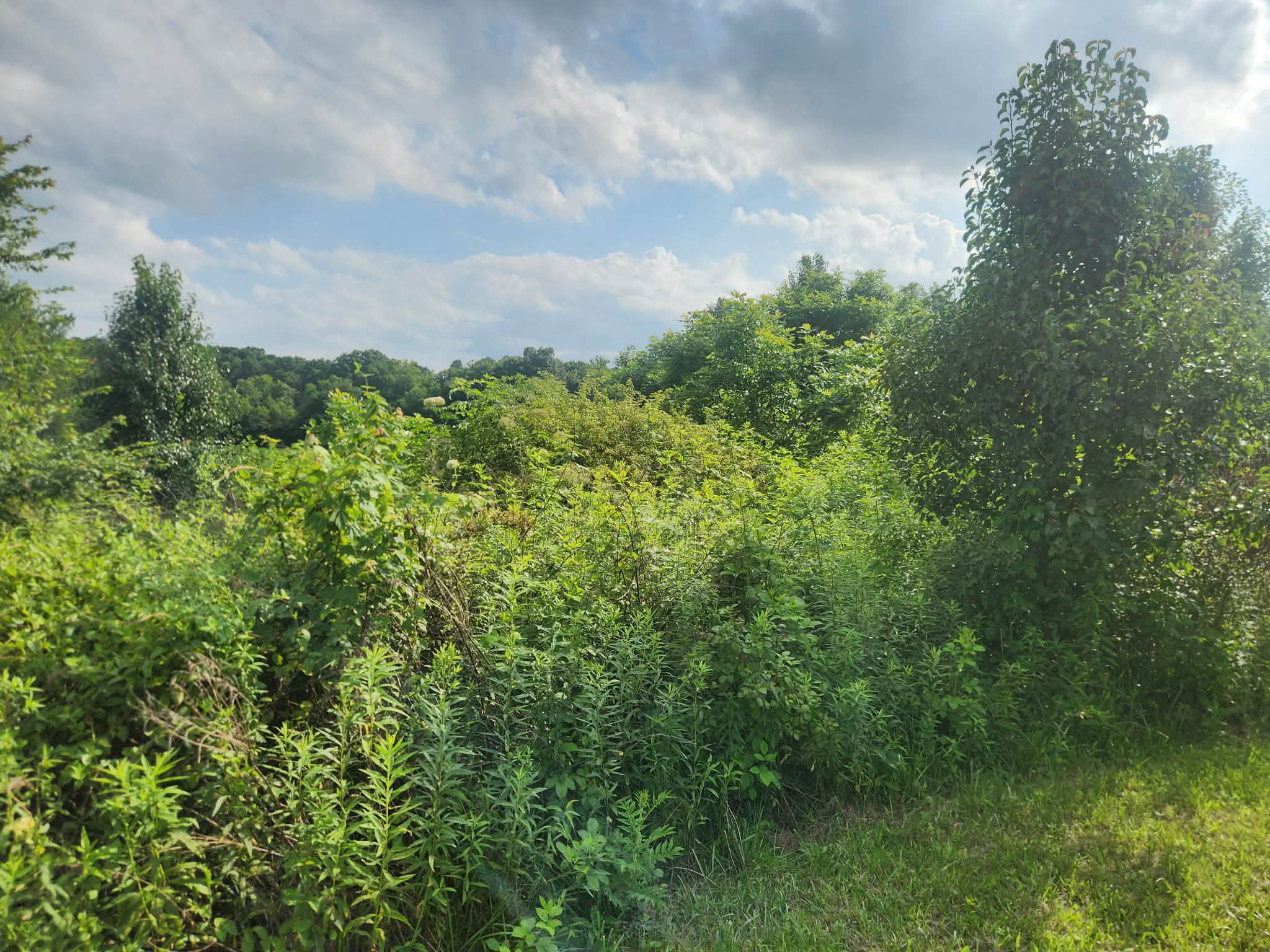
Walk out and look at the stems, not the height. Grass, goldenrod, thistle, and first-year briars are brush hog material no matter how tall they are. Cedar, black locust, autumn olive, multiflora rose that has been building for five years, and volunteer maple and sassafras are not.
The practical rule: if you can snap it by hand, a brush hog will cut it. If you would need loppers or a saw, you are looking at mulching.
What happens if you brush hog it anyway
Two things, neither good. The woody stems that survive get cut off at an angle a few inches up and become a field of sharpened stakes, genuinely dangerous to walk, and hard on tractor tires and ATV sidewalls for years afterward.
And you have not solved the problem. Cutting the tops off woody growth without touching the stump encourages it to come back thicker and multi-stemmed. A field brush hogged annually for a decade is usually worse than one left alone, because you have been pruning it.
The honest cost comparison
Brush hogging is cheaper per acre and always will be. It is a simpler machine doing a simpler job. If your ground genuinely only needs mowing, paying for mulching is wasted money.
But comparing them on price alone is comparing a haircut to a demolition. The right comparison is between mulching now and brush hogging repeatedly forever while the woody component gets worse. On ground that has already gone to brush, mulching once and then mowing to maintain it is the cheaper path over any horizon longer than a couple of seasons.
A common middle path
Plenty of properties want both, in sequence. Mulch the ground once to reset it, taking the cedar, the locust, and the rose down flush, then keep it open with an annual mow. That combination is far cheaper than repeat clearing and it holds the ground indefinitely.
If you are not sure which side of the line your property falls on, send photos taken from the edge of the growth at ground level. We can usually tell from a picture, and the answer costs nothing.