
Forestry Mulching · 6 min read
Forestry mulching gets described as "clearing" often enough that people assume it is just a different brand of bulldozer. It is not. The machine, the finished ground, and the bill all behave differently, and the differences are worth understanding before you decide how to handle an overgrown piece of property.
Here is what mulching actually gives you, in the order landowners tend to care about.
Nothing leaves the property
Traditional clearing produces a problem the moment it starts working: a pile. Everything the dozer pushes has to go somewhere, which means burn piles smoldering for a week, roll-off dumpsters, or a line of dump trucks going in and out of your driveway. All of that is time and all of it is billable.
A mulcher grinds standing material into chips where it stands. There is no pile, no burn permit, no hauling fee, and no second mobilization to come clean up. On a lot of jobs that single difference is most of the cost gap between the two methods.
The topsoil stays where it is
This is the benefit landowners underestimate most, and it matters enormously on the ground around here. Traditional clearing rips roots out. On the hillsides and hollows of southern Ohio and eastern Kentucky, pulling the root mat off a slope means the first hard rain after the job starts moving your soil downhill.
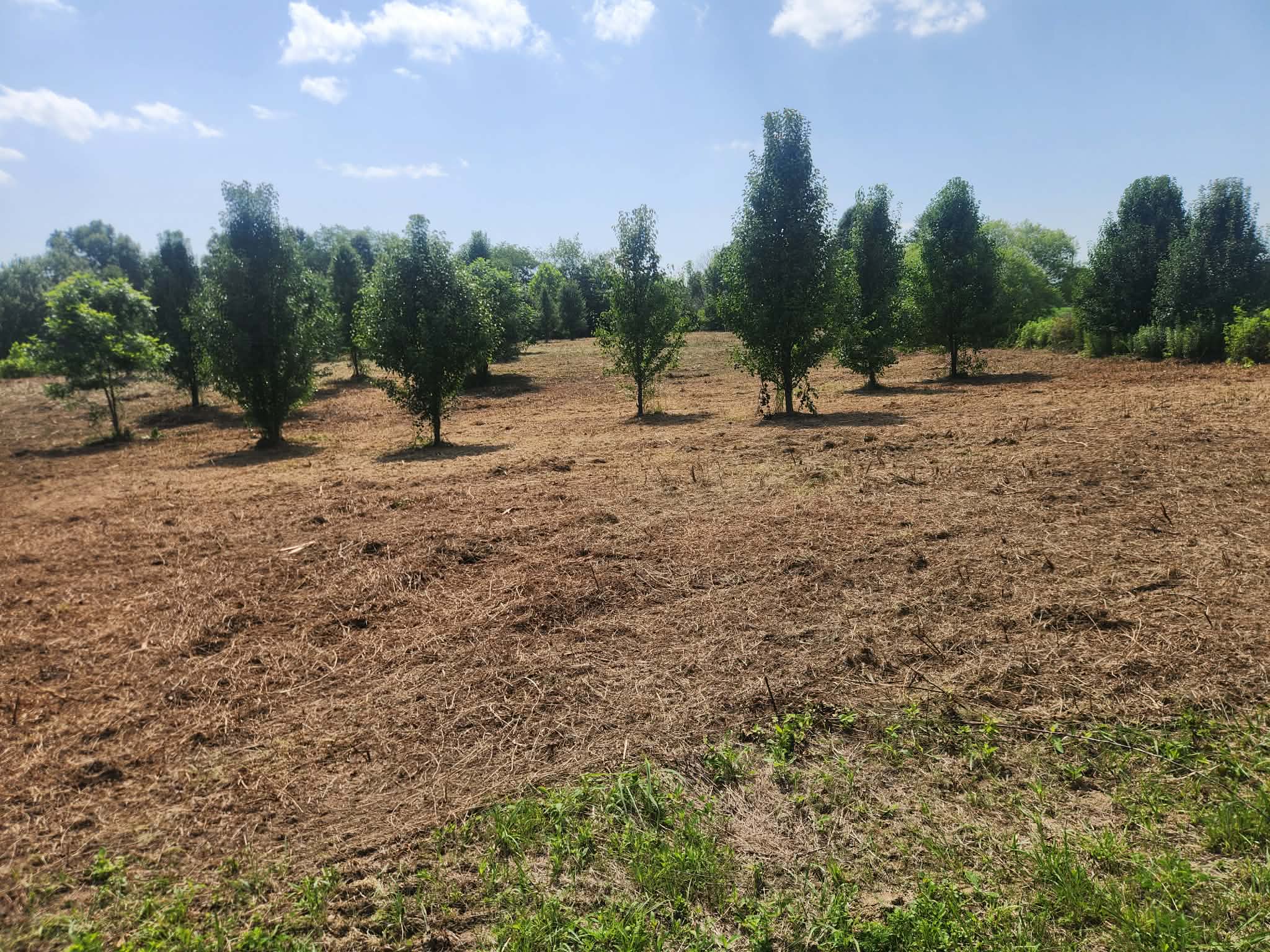
Mulching cuts at the stump and leaves the root network intact. The ground holds together, and the chip layer on top acts as erosion control while the roots slowly break down. You get open ground without buying a washout.
You choose what stands
A dozer blade does not negotiate. A mulching head is selective stem by stem, because a person is deciding in real time what comes down and what does not.
That means you can keep the hardwoods, the den trees, the shade over the house, or the timber that made you buy the lot in the first place, and take out everything underneath. Mark what you want kept, or just give the operator a diameter cutoff, and the rest disappears around it.
Days, not weeks
Typical brush and saplings run one to three acres a day. Most residential and hunting-property jobs finish inside two days, and there is no return trip to deal with debris, because there is no debris.
Heavier stems slow that down, and slope slows it down more. But compared with a clearing job that stages three machines and then schedules hauling, the whole thing is over quickly enough that you are not living around it.
The mulch is doing work after we leave
The chip layer is not waste. It holds moisture through a dry August, suppresses the seed bank underneath it for a season, protects slopes from rain impact, and feeds the soil as it breaks down. By the second year most of it has become part of the ground.
The one thing to plan for: a heavy mat will slow grass down while it decomposes. If your goal is pasture, lawn, or a food plot, say so before the job starts and the material gets spread thinner so you can seed sooner.
Where mulching is the wrong answer
It is worth being straight about the limits. If you need bare, buildable dirt, whether that is a house pad, a barn footprint, a pond, or a driveway cut, you need the stumps and the root mat gone, and that is land clearing, not mulching.
If the target is grass and light weeds rather than woody growth, a brush hog is cheaper and entirely adequate. And on genuinely saturated bottomland, the honest answer is to wait for the ground to firm rather than rut a field you have to look at for two years.